Mow Your Own Lawn

My father never allowed my brother and me to leave the dinner table without first offering our mother the requisite “I enjoyed it” statement of gratitude and respect. This didn’t feel like too big of a deal to me since even if the meal consisted of black-eyed peas, cornbread and milk, mom always seemed to find a way to make the meal enjoyable. She often even scraped together the simple ingredients to make a chocolate pudding that was worthy of plating at any five-star restaurant. So we almost always did enjoy dinner.

What was maddening to me about dinner was the presence of my father at the head of the table, watching him enjoy the meal with some twisted sense of pride and accomplishment and knowing he’d done little to provide the resources necessary for the meal. I dreaded the end of the meal the most, knowing what was coming as dad would inevitably, in a satiated state that sparked a magnanimous spirit so contrary to his true self, end the meal by ceremoniously offering to help with cleaning the kitchen. Mom always feigned delighted surprise, joining the charade by replying, “That would be wonderful, Billy,” while I white-knuckled the chair under the table knowing full well what was coming next.

“Kaysie, help your mother clean the kitchen.”

He then promptly propped up his feet, popped open another Pabst and lit a cigarette.

That was his way. He regularly swept in and took credit for the work that others were doing – usually the others were my mother, my brother and me.

The lawn our little house on Archwood sat on was my father’s pride and joy, and he took great care to make sure I attended to all the details of keeping it manicured to his satisfaction.

I learned how to push a mower around the age of eight, with Dad either standing over me with a cigarette hanging out of his mouth or sitting off to the side in a lawn chair with a cigarette hanging out of his mouth – but either way, he did plenty of pointing, yelling and criticizing when I let that heavy mower veer to the side and missed a sliver of grass.

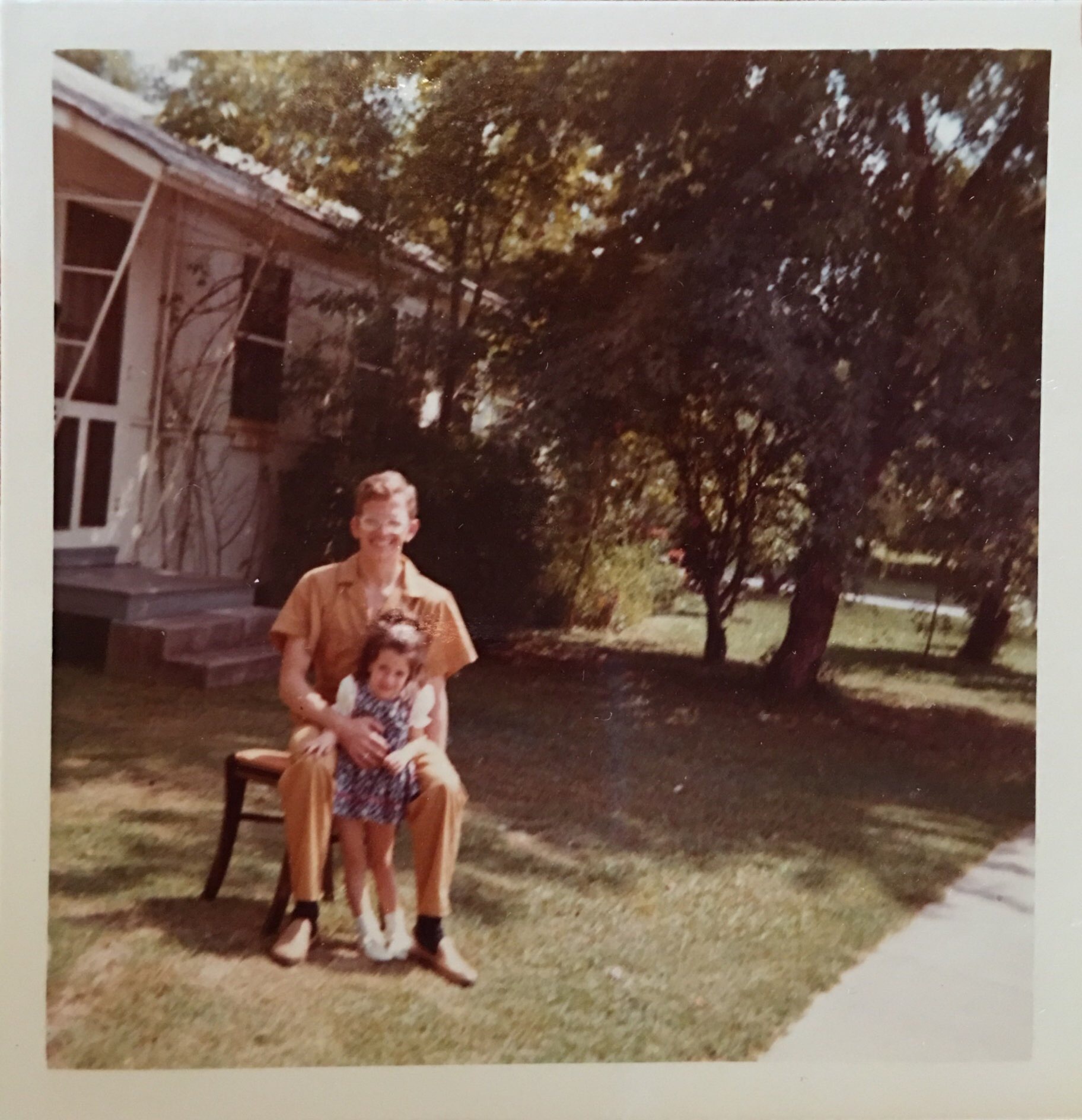
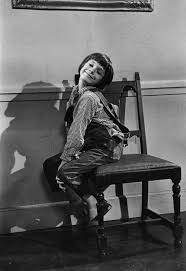
Not actually me.

When Mark and I were raising our older three children, and our oldest (and only daughter) hit ten, I began to nag Mark about teaching her to mow the lawn. He looked at me like I was a crazy person.

This pissed me off.

What?

She was ten! Isn’t that the age you learn to mow? In fact, isn’t that LATE?! Weren’t all the other kids who were ten already mowing? When our sons came of mowing age a couple of years later, I about lost my mind. Are you freaking kidding me?!! A ten-year old boy isn’t old enough to take over the mowing responsibilities?!!!

My poor husband. Thankfully, he held his ground and protected our children from my ignorance about such things. Not that it’s inappropriate to begin to teach and bring your own children into the family process of working TOGETHER to take care of the lawn. Yes, of course that’s completely appropriate. But that’s not what was happening in my childhood home. So it took some reframing on my part since I thought it was very normal to be responsible for the lawn by the age of eight or nine.

Of course, I also thought it was normal to be responsible for the emotional stability of my family at the age of eight.

So there’s that.

My brother has been doing some writing of his own as of late (copycat) and recently sent me an essay reflecting on his experiences with dad and the lawn that really prompted all this musing on mowing. In fact, his writing threw me into a spiral of sorts because he has a way of writing that really places the reader in the moment with him – living it, if you will.

Or RE-living it if you’re me.

Not fun if you don’t care to relive those moments.

I do not.

My therapist, though, is quite pleased it’s happening, insisting it’s a necessary part of my healing journey.

Journey, shmerny.

Since reading that lawn mowing essay of his, though, I’ve been doing a helluva lot of lawn mowing. Not literally. In my dreams. While awake I close my eyes and see the rows of cut grass – but then there’s that one line I missed, and my stomach drops. Or while actually sleeping, I push the damn mower back and forth over and over across that giant lawn in the heat and humidity of summer in Tennessee. Or I finally finish and go inside the house so glad to be done and so ready to cool off, only to be ordered back outside by my father because I didn’t rake up all the grass and bag it.

And I’m tired. Like, deep in my bones tired. In the present, not in my dreams.

While reading my brother’s essay, I discovered that my mom was watching the mowing shit storm from inside the house, and I didn’t know. My baby brother wrote about his memory because even as a preschooler he was insightful enough to know something was wrong with what was happening, and the memory cemented itself in his brain… and then connected it to his own mowing woes with dad later on.

Yeah.

The revelation of her awareness has been a sucker punch to me. I know it must be obvious to most that of course she was aware of what was happening to us and should have done something to stop it. But it is a new way of thinking for me to see my mom in this light when I have always placed her as just another victim in our family, or even as someone I needed to look after.

But, no, mom was watching, mom was aware, mom was participating in the charade at the dinner table, and mom needed to step in and tell my father to get off his ass and mow his own damn lawn.

If You Don’t Cry

A playground in the 1970s was the most dangerous place for a child to be.

First of all, there was rarely any adult supervision.

Second, the play equipment was more along the lines of an American Ninja Warrior course…minus the safety nets and water underneath the hazards.

The swings alone were responsible for countless injuries. Those wooden planks with steel bolts held massive steel chain links that burned your skin off in the Southern summer heat and collided with the head of many a child who miscalculated the pendulum of the swing.

Yes, I was one of those children.

We lived in an apartment complex in Nashville, Tennessee for two years when I was five and six years old. The complex had one of those ninja playgrounds complete with a massive swing set, a solid steel merry-go-round that spun so fast the real challenge was to avoid being thrown to the gravel ten feet away, a steep metal slide with a ladder that threatened death, and a wooden see-saw that seemed out of place in that sea of metal.

The see-saw, however, had dangers of its own. My five-year old self can’t accurately measure the length of the wooden plank that made the see-saw, but it was so long that the real draw of the thing was the slide up and down the length of it. Its wood was weathered, making the top smooth and slick, and excellent for sliding. If I could convince two sturdy kids to sit on the ends and be the bobbers going up and down, then I could enjoy the sliding. I had quickly learned that the role of bobber was not for me. Control over when the other kid might bail and send me crashing to the ground from the full height of the see-saw was, quite simply, something I was unwilling to surrender.

So I was the slider.

The thing about this slide was its edges. Yeah, it was smooth and slick on top, but the sides were not only rough, they were splintered and breaking down. One day as I slid, I held onto the sides a bit too tightly and felt a painful prick in my left hand. When I looked down, there was a tiny drop of blood at the entry point, but across the entire width of my palm was a giant splinter measuring three inches long.

No big deal, right?

But it was.

No one could get it out. My parents took turns poking and prodding and pulling and tweezing while holding me down, as I screamed and writhed underneath them. They had neighbors come over and attempt the same. My poor little hand was traumatized with the effort.

My soul wasn’t faring much better.

It. Was. Not. Budging. Much to my father’s chagrin, we needed help. These were the days well before urgent care centers were on every corner, so we had one option – the emergency room. And, for reasons I will never understand, my father was the one who took me.

At the hospital, I was placed on a thin, metal bed in a freezing cold room with bright lights above me. I remember the hospital staff around the bed with their blue gowns and masks on. Someone walked over to my left side and strapped my arm down and out away from my body.

Then, suddenly my father’s face was above mine as he said to me, “Kaysie, if you don’t cry, I’ll buy you whatever toy you want from the toy store.”

Now, before I continue with the story, I think it’s important to note here that I can count on one hand the number of times my father bought me a toy. This includes Christmas and birthdays. So, you can imagine how he was able to get my attention with the above proposal.

Five seconds later two masked doctors stood on each side of my arm. One of them pulled out a huge needle, told me to hold still, and injected it into my hand.

I mean, for crying out loud.

Except, I couldn’t cry out loud.

We’d made a deal.

Kind of.

I never really agreed, but I never said no either. Not that there was time. Between the shock of what was happening to me, the sheer lack of comprehension of it all, and the blinding pain I was experiencing, it was all I could do to keep the contents of my stomach inside me.

But I didn’t cry. I didn’t scream. I didn’t shout. I held my breath or barely breathed, pinched my right leg with my right fingers as a distraction (a coping skill I’ve held onto, by the way), and held still just like the doctors asked, while they surgically removed a three-inch piece of wood that had embedded itself in the muscle tissue of my hand.

Because as soon as I heard my father say toy store, the game was on.

I don’t think he was baiting me. I don’t think he was daring me to see if I was gutsy enough to get through the procedure without crying. I think my father was a coward.

Looking back on the situation now, as an adult and a parent of four children of my own, who has accompanied each of them to the ER for various needs (some of them multiple times, bless their exhausting little hearts), it feels to me that he knew that it was going to take everything he had, which wasn’t much, to get through my procedure, so he was desperately trying to find a way to make it easier for him.

Because you see, there were no hospital vending machines for gin.

And gin was how he got through the things.

But you know what? I wasn’t thinking about that at the time. At the time, I was focused on one thing…this:

And I wanted it bad. Just real bad.

I wasn’t a doll person, typically, but THIS doll was primo. I mean, she ate, she drank from a bottle, AND she peed in a diaper! It wasn’t a toy! It was like having a real, live baby!

Spoiler alert: not so much.

After the procedure, I was placed in a wheelchair and wheeled into what must have been a holding area with my dad. I didn’t know this, of course.

Why didn’t adults talk to children in the 70s?

My dad must have decided he would die without a cigarette at this point because he told me he’d be right back and left me sitting there alone in my wheelchair. Suddenly, a nurse approached my chair and began wheeling me down the hall to another room…without an explanation and WITHOUT MY FATHER. She was one of those lovely no-nonsense nurses, so without fanfare, she pulled up my right sleeve, sanitized my arm and gave me what I now know was a tetanus shot.

For the love.

After that little bonding session, I was returned to the holding area just as my father turned the corner, so No-Nonsense Nurse Nancy passed me to him, and I feel confident he was quite relieved to then walk his five-year old stitched, splinted and dry-eyed daughter out of the hospital.

I never shed one tear and, for once, my dad was true to his word. My Baby Alive was delivered to me brand new and in the box by my father later that same day.

I gotta tell ya, though, I paid way too high a price for a doll that kept getting clogged with baby food.

Because this became a pattern between my father and me.

Once I proved my strength in a crisis, I guess he thought it meant he could expect me to step up the next time it was needed. And the next time. And the next. And so on.

I guess I thought so, too.

You know, I never went back to the middle of that see-saw. I realized that the bobber position was perfect for me after all.

Choosing Life When Death Is All Around

I spent many happy hours playing in a funeral home as a child.

Not the likeliest play place for a child, granted, but for me it was quite the haven.

We visited my mom’s hometown of Belmont, Mississippi frequently throughout my childhood. It was only a couple of hours away from where we lived, so we drove over there about once a month if someone (usually her mom or brother) paid for the gas to get us there.

This tiny town had one stoplight in the whole of its intersections, and I’m pretty sure I was somehow related to a good 80% of the population, so there must have been an enormous feeling of safety for Mom when we were there.

She felt known there. She felt cared for there.

I did, too.

In Belmont, Mom had her mom, a brother and two sisters, and an extensive extended family. Her father died when she was only five years old in a freak boating accident. He was a hero in that small town – a WWII vet and an entrepreneur – and he left behind a funeral home business that was just beginning to thrive.

Fast forward to my childhood, and my great-grandfather, great-uncle and uncle ran two funeral homes that served much of northeastern Mississippi.

It was the lifeblood of the family.

When death is essential to your livelihood, your experience with it and around it is very different than the norm.

My uncle, aunt and my cousins lived in the apartment above the funeral home, so when we were in Belmont I spent the night there with my cousin, Karissa.

I anticipated those sleepovers, but I look back now and think of the language the adults used around us with a tiny bit of horror.

“Where are Kaysie and Karissa sleeping tonight?”

“At the funeral home.”

“But Mike went to Corinth to pick up a body. Who’s going to be with them?”

“Well, Sandra will, I reckon.”

There were bodies getting picked up all the freaking time.

I mean, my kids would die.

But this was my second home.

My cousins and I played hide-and-seek in the casket room. Sometimes we extended that game beyond the boundaries we’d been given (I mean, this is me we’re talking about), and we’d stumble into one of the embalming rooms where a body was being prepared for the memorial service and burial. And, yes, I snuck around to those doors when my uncle was working to see what I could see.

I mean, of course I did.

Unfortunately (really, thankfully), he was mostly very good at keeping those doors shut tight.

The funeral home chapel served beautifully as a school, a store, a doctor’s office and a church where my cousins, my brother and I spent many happy hours pretending.

I learned to mow in the nearby cemetery. When I was ten, my uncle was the first to put me behind the wheel of a vehicle, and it was on the country road that led to the cemetery.

My mom is now buried in that same cemetery.

We had her memorial service in the same chapel where we played school and church as children. It was literally standing room only…packed with those who came to honor her life and show us their love and kindness.

Her body was lovingly prepared for burial by my first cousin, Jonathan, who spent all those years playing with us, then grew up and became a part of the family business.

His older sister, Karissa, coordinated the entire funeral service, plus the burial and all the flowers and the meal afterward and so many things I don’t even know about, because when your mother dies you can’t think straight, and you really just about lose your mind. Karissa also grew up and became a part of the family business. She was my first playmate as a child, and she was an angel for me during some of the darkest days of my life.

These people who took care of all the death things when mom died were also the people we ran to at least once a month growing up because my mom needed a safe haven from the death we lived in every day of our lives at home.

We experienced more life living in and around that funeral home as children than we ever did inside our own home.

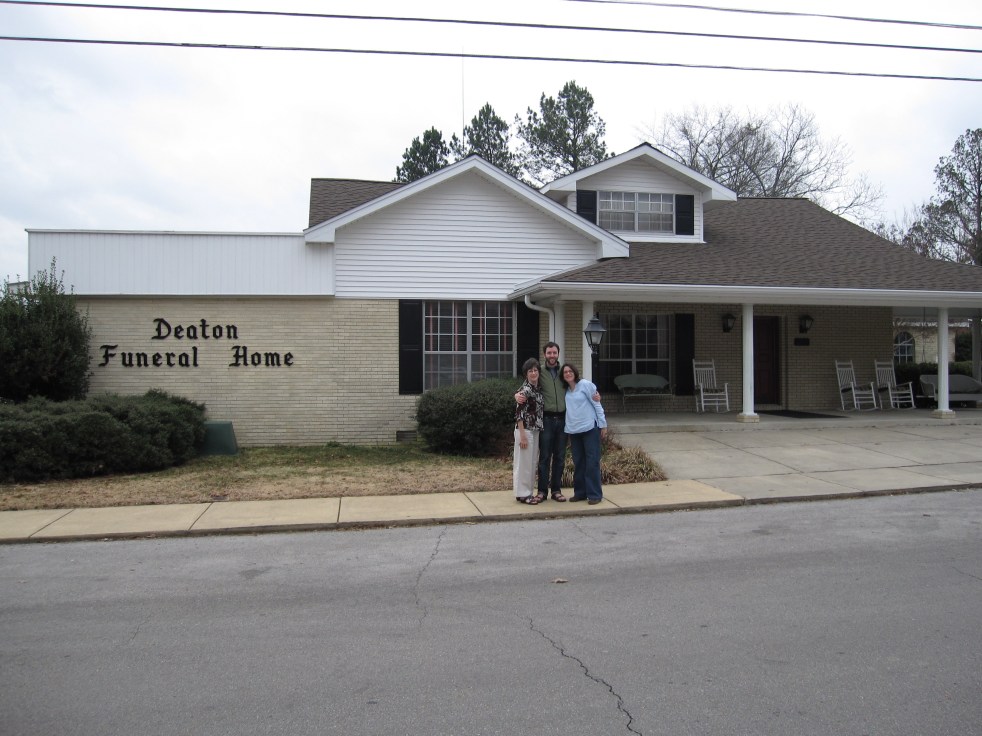
In 2009, Patton and I went back for the first time to visit Mom after she was diagnosed with breast cancer. I was seven months pregnant with Davy, my fourth child (just in case you’re unclear on why the giant belly).

After forty years of marriage to my father, Mom finally saw the death in her marriage, made the hard choice and ran home to stay. She was embraced by her family and friends there and allowed the space to begin to heal. She rekindled a romance with her high school sweetheart, Jack, and found true love.

Mom was given 11 years of love and at least some seasons of wholeness after the choice to walk away from death and into life.

My father, though, after forty years of keeping mom ensnared by telling her he would die if she ever left him, did just that. He died just ten months after she left. Alone, with nothing and no one.

Talk about self-fulfilling prophecy.

I don’t know why mom stayed with dad for as long as she did. I can guess at it and probably hit on the top five reasons pretty well.

  • She didn’t think she could raise two children on her own. (She did anyway, by the way)
  • Religious teaching at the time was consistent with the cultural norms in the South that said women were inferior to men and should stay in a submissive and committed role unless he commits adultery. She was literally being indoctrinated with this even though her husband was drinking away all of the provision for the family and at the very least abusing her emotionally, while also abusing his children.
  • She really, really, REALLY wanted to hold on to the hope that he would fulfill his promise and someday change.
  • She didn’t want to be a burden on anyone else.
  • By the time we were older, she didn’t want to raise us in a small town.

It’s hard to look at this and wonder at why she stayed in this tomb of a marriage for so, so long. Painful, even.

But in the end, here’s what I really do for sure know… Mom tried really hard to choose life in the midst of death and Dad always chose death in the midst of life. This meant that my brother and I were given many lessons in life from our mother and many lessons in death from our father.

You can guess at who we preferred as a teacher.

Belmont, Mississippi is now a sleepy little town. It was a little sad to drive through and around so many places of significance to me as a child and see that they were gone or stagnant.

But when death came for mom and we gathered there for her memorial, life was teeming all around her.

I’m really glad she chose to live.

October 2017 at an oncology visit just five months before Mom died.

My Brother’s Keeper

If you were a kid worth your spit in my neighborhood, you had a BMX bike.

There were a couple of exceptions…

A couple of banana-seaters who were still pretty daring on skateboards and sledding hills… and my baby brother.

That kid, with his light brown curly locks and big blue eyes, could follow us anywhere. I’d dash for the door as soon as I was released from my chores or homework, but without fail that little guy would catch my eye on my way out, and simply ask, “Can I come, too?”

And even though Patton insists on memories of being sad because I left him at home, the truth is it was rare that I told him anything but yes, although I may have done my share of age-appropriate moaning and groaning about it from time-to-time.

And as long as he could keep up, NO ONE was sending him home.

The Christmas I got my BMX is seared in my memory.

Most of our childhood Christmases were donated, and I was well aware every year that it was never a given that we would receive much of anything outside of what our extended family gave us, so I was overjoyed to see that most desired of all items under the tree that year.

It was a beaut. A shiny blue Schwinn with spiked pedals and everything.

Kids these days get bikes to ride with helmets up and down the same street with their parents watching the entire time.

So lame.

Kids in my day rode bikes all over the freaking town.

A bike pretty much meant total freedom.

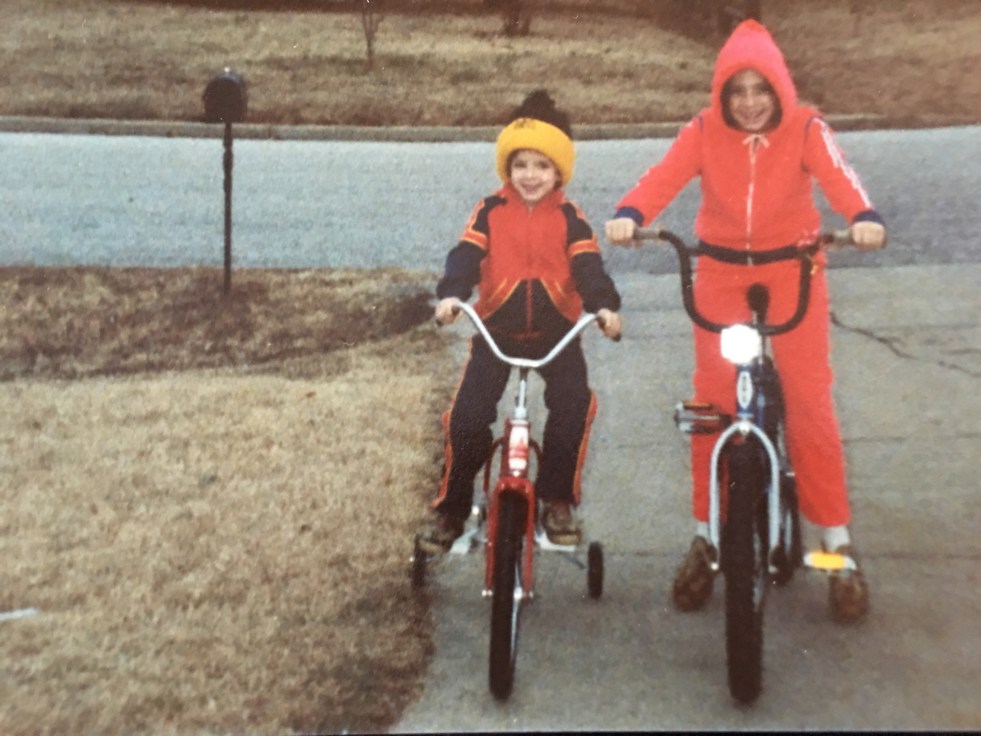
Oh, and that baby brother I mentioned above? He got a little training wheel bike. Bless.

God, he was cute…but that bike was getting him exactly nowhere.

It was okay, though. When he couldn’t keep up on that, he fit just fine on my handlebars.

Our neighborhood was filled with a passel of kids all around the same age, and we tended to move around as a unit, finding ways to stretch the limits of our BMX skills.

We thought we were awesome.

We loved to jump…for height, for distance, for dares… and just for the heck of it.

One afternoon, a neighbor boy brought out a new ramp he’d built for us to take turns jumping. This ramp was special. It was about three feet tall with a long slope leading up to the edge — not necessarily built for acquiring great heights, but, man, if you came at that ramp with some good speed, you could really go the distance.

You know how I know?

That day we decided to measure our jumps.

Keep in mind that these were the days before sidewalk chalk, and none of us were stupid enough to risk our lives by swiping the treasured tape measures out of our dads’ tool boxes.

So we came up with a genius plan.

We decided to use our own bodies to measure the jumps.

Laying our bodies on the pavement, making sure to place the youngest (my baby brother) on the outer edge, we started with a reasonable number – FOUR – and added children from there.

It was thrilling.

There’s nothing quite like the feeling of the back tire of your BMX just barely clearing the left femur of your five-year old baby brother.

I cleared six kids.

The neighbor boy who built the ramp astonished us all by clearing ELEVEN kids.

And then, as we were setting up for the next jump — where I was going to attempt seven kids (Dear God) — across the street I saw Loyce Ann Frankland, one of the moms, come crashing through her front storm door, all the parts of her body swinging with the rhythm of her frantic dash across the front yard, while screaming, “STAAAAAAAHHHHP!!”

I don’t know that hysteria and verbal thrashing is the best combination for getting a reasonable point across, because even after the massive “talking to” we received that afternoon, I was a grown-ass woman with my own children before I fully realized how serious things could have turned out that day — especially for my little brother.

Honestly, I’m not sure how my brother managed to get through second grade.

Oh, his grades were fine. It’s just that I was the one keeping an eye on him most days, and I think it’s well understood now that children don’t do a great job at taking care of children.

This wasn’t understood then, though. At least not in my house. In fact, I think my brother was considered better off if he was with me. I know I for sure felt that way.

I rarely left him at home. It was either too damn sad, too damn lonely, or worse — too damn scary.

But when I think about it now, and examine some of my behaviors towards him that conflict with the sense of responsibility that I felt for him, I can see that with the sense of responsibility and love I felt came feelings of anger and resentment.

I’m not sure how I didn’t clearly see it before. It’s kind of embarrassing, really.

I mean, the kid would lay on the floor with his giant red blanket, sucking his thumb and minding his own business, when I would walk through the room and, instead of walking around him like a normal person, or at the very least jumping over him like an active kid, I stepped ON him as I moved through the room.

What in the actual hell?

One particular display of rage left its mark on us in different, but definitely troubling ways. When Patton was three, and I was eight, I was on my bed drawing or writing something, and he wanted my attention. I was busy, so his problem-solving resources went into action to try to get my attention. Like any conniving little brat of a three-year old, he proceeded to swipe my pencil, causing me to mess up what I was doing. I asked him to stop, erased the mess and started over. He did it again. This time, I TOLD him to stop, fixed it and started over. HE DID IT AGAIN. Now furious, I did what anyone would do in the same situation…

I stabbed him in the arm with my newly sharpened pencil.

I know, I know. You’re thinking, “What? That’s not a big deal.”

No. I mean.. I broke the pencil in my three-year old baby brother’s little arm.

Yep.

And 40 plus years later, that lead is still there. This is the mark left on Patton.

I just about had the life beaten out of me for that, by the way.

And I 100% believed I deserved that beating. This was the mark left on me.

I still have a hard time explaining to myself that I was a child often looking after a child…and shouldn’t have been. The level of responsibility that I not only felt for my brother’s well-being, but was expected to shoulder as well, was immense. The truth is, there were times when I tried to say no to taking him along with me on my adventures — and guess what? Inevitably, I was told to “look after your brother.”

So, yeah, I felt responsible. And I felt guilty.

If I’m honest with myself, the responsibility I feel for my brother continues to be out of proportion to what is generally expected and acceptable to a typical family. I will at times make statements that cause close friends or family to stop me and remind me that he is an adult human who I am not responsible for…bringing me to tears as I try to wrap my mind around this truth that does not feel true.

So why the cruelty and dismissiveness towards him when I so clearly loved him and desired to keep him safe from whom/what we most feared?

Well, first of all I think I was just a really pissed-off kid. Pissed-off kids sometimes do mean things — especially to those closest to them.

I needed a punching bag. I needed to feel big and strong and in charge, and I was certain to feel that way when I had my baby brother in my control.

But also, I needed to take big risks so I could feel like I was in control of some of the chaos in my life, and since my brother was always with me, there was no separating him from the risk. Not in my mind anyway.

I think when you mix a craving for risk and danger like the one I had and the immaturity of an 8,9, or 10 year old… you’re just for sure creating a recipe for disaster.

Thankfully, disaster never came.

I never even broke a bone. His OR mine. He never needed stitches (I did, of course — several times) in my care, never got stung by a bee in my care… I don’t think the child even got a splinter while he was in my care.

What’s everyone griping about anyway? He’s obviously perfectly fine.

Aside from that pencil lead thing, I mean.

Words, Words, Words

My mom loved to tell the story of the morning she came to get me from my crib when I was just ten months old, and I looked up at her and said, “I want one now.”

These were my first words.

Ya’ll, I’ve had four children, and I’m here to tell you that if my ten-month old spoke words to me – ANY actual words to me – I would freak the hell out.

This is not natural behavior for babies.

But my 21-years young mom didn’t really know any better, so she simply asked me what exactly I wanted “one” of and gave it to me.

Done. Check.

I wanted a pacifier, by the way.

It was probably my way of saying “Get me the hell out of this crib,” too.

Cribs are a funny thing. They’re meant to be a space where we can place our most treasured humans and feel certain that they will be safe from harm.

But I’m guessing that to some children that barred bed is often less a safe space and more the prison cell it looks like.

That could explain the time I forced my toddler-sized head through those bars and got myself quite stuck, requiring the sawing of said bars in order to get me out.

Bless my mom. She had a LOT going on.

Imagine being 21 and married to a drunk, PLUS mother to a talking dare-devil baby.

That first baby-talking incident must have been the beginning of my sense for the utility of words, whereas the love that I eventually had for words and the almost compulsive need within me to use them to make my way in the world sparked not long after and certainly never left, even if the medium of expression perhaps changed now and then.

I was reading fluently by the time I was three.

No, I don’t think I was exceptionally smart.

I was certainly precocious.

And words just came easily to me.

In my first three years of life, my father dragged my mother and me with him across Mississippi and Tennessee, preaching in small churches but never staying long enough for the truth of his lifestyle to come out. My mom didn’t mind my chattiness. In fact, I think she relished it. It soothed her. I guess I wasn’t the only one who needed a pacifier while in a cage.

I think my father enjoyed my constant flow of words, too. I could charm the socks off the congregation of the church during the welcome dinner, allowing some grace to fall on whatever his state might be at the time – given that his “state” was usually somewhere between edgy and slightly inebriated to barely functional and totally sloshed.

I was pretty handy to have around.

When my brother came along, I became his “words.” For whatever reason, our parents couldn’t understand a word that came out of his mouth until he was about four, so until then they relied solely on me to interpret for him.

Bless.

I remember one day he came running into the living room, babbling desperately to the bewildered adults there, who, of course, turned to me.

For the love.

And yes, I understood perfectly what he was saying and interpreted for them with as much condescension as my seven-year old self could muster, “He wants the clown mask in the top-left corner of his closet.”

Sheesh.

As I grew, I became quite skilled at using my wordsmith superpowers to collaborate with my brother and masterfully distract mom from the reality of our situation. We were the perfect pair. Patton’s dry wit and my dripping sarcasm, along with her ability to take our good-natured, but unrelenting teasing made for constant entertainment in the midst of what was often otherwise a miserable existence – especially for her.

Distraction was good medicine, and words made that possible when not much else was available to us.

But here’s the thing about how words work in the home where the driving force is alcoholism.

You think they work, but they don’t.

Because even though I could wordsmith my way around and through many things, my words never changed my father.

And I had more power over him than anyone else in the house.

I’m not sure why that is.

He certainly had plenty of power over me as well.

But when I was older and dad was working more consistently, if I was with the family when we went out to eat, he asked to eat in the non-smoking section and didn’t order alcohol with his meal.

And he never smoked in the car when I was with him.

These were weird and small, but noticeable boundaries that he started observing when I was maybe ten.

I think my complaints, my obstinance, my unwillingness to just take it from him worked in these areas, insignificant as they were.

And honestly these small victories for me were defeating in many ways because power with great limitations is just… bondage.

It’s funny how I felt so strong about confronting him when it came to his smoking in the car or, later, in the house. I could argue with him for days about what smoking was doing to him. Eventually, by the time I was in college, I even got brave enough to hunt around the house and pull out all his hidden bottles of cheap liquor, pile them in the middle of the kitchen table, and prepare a speech meant to convince him to “finally” face the truth and admit that he was an alcoholic and needed help. My brother and I would do it together, and my body would fill with a very persuasive energy assuring me I had the upper hand this time around.

And it was a lie. Every time.

And the really upending part of this story is that it played on repeat.

For 38 years – until the day my father died.

Well, okay. I’ll cut myself some slack and say that I managed to stop believing my own lie a few months before he died, when I finally realized my words actually held no sway over my father.

Growing up a wordsmith child of an alcoholic makes for a complicated human. Although I am hard-wired to use words to make my way in the world, my childhood experience makes me reticent when futility lurks in the shadows.

And so when words are required to make progress say, in the realm of my own emotional and mental health, I can get quite stuck.

It’s hard to unlearn the things we are absolutely convinced of in childhood.

My brother’s middle child, Henry, who shows the kind of economical wit most grown men never achieve (Don’t tell him I said so.  It’ll go straight to his head, and I just can’t have that.) likes to welcome my wordsmithing family to his Texas home with his charming freckle-faced smirk and a dripping with sarcasm Words, words, words to his mom.

The boy doesn’t yet appreciate what my voice can bring to the table.

And when it comes to the emotional work I’m needing to do, I’m not sure I do either.

What She Asked of Me

My dad had a little red convertible when I was about three or four years old. I can’t imagine how he acquired this car. Seriously. It baffles me when I think about it now knowing what I know about the ongoing financial state my parents were in.

But, oh, how my dad loved this car.

And now that I think about it, maybe the car didn’t belong to him at all…. maybe it was a friend’s, and dad just borrowed it from time-to-time.

Much more likely.

But he sure drove it like he owned it…

his smile exposing the dentures he’d been flashing since the age of 17, and dark, horn-rimmed glasses sitting awkwardly on his small, always too-thin face.

Bless.

Dad loved cars, but he wasn’t educated about cars. He could change a tire (with the help of his children, of course), and he was OBSESSED about checking the oil level, but these were the extent of his mechanical abilities. Really, I think he just liked the feel of a steering wheel in his hands and the long stretch of highway in front of him that spoke of possibility.

Are all addicts dreamers?

Asking for a friend.

Two weeks before he died, weighing all of about 100 lbs, he somehow charmed a car salesman into selling him a used car…completely on credit with no down payment, no income, and ON HOSPICE.

The man wasn’t even well enough to drive.

And never would be.

EVER AGAIN.

For crying out loud.

But in 1973 dad could drive just fine, and that little red convertible made for a sweet ride. Those were the days when seatbelts weren’t a thought in the minds of most drivers, and carseats for toddlers didn’t even exist in the US, so you better believe this four-year-old Evel Knievel wannabe was happy as can be standing on those red leather seats with the smell of the Southern countryside in the air and her long black hair blowing in the wind.

My mom, who didn’t go with us, always had a curious way about her before we left. She made sure to stop me on my way out the door, where she would put her hands on my preschool-sized shoulders and say, “Kaysie, don’t let your Daddy drink while he drives.”

I think my mom, in her desperation as a 23-year old young woman grasping at whatever she thought might give her something solid to hold onto in the chaos of our world, grasped hold of me.

Of course, I’m sure I said “yes ma’am” just as I should and probably skipped on out the door with nary a second thought.

But, yeah, I felt responsible.

Guess what my dad did just as soon as we pulled out of sight of the front door?

That bastard reached under his front seat, pulled out a Pabst Blue Ribbon, popped the tab and started chugging while singing the little song he’d made up just for me, “Kaysie is my little girl… yes, she is, my little girl…”

I kind of loved and really hated that song at the same time.

Driving with that stash of beer under his seat was dad’s signature move. He had a way of hiding things in plain sight with a genius level naiveté.

I don’t know if dad feared that his young daughter would tell his wife he’d been drinking and driving and she’d get all up in arms about it. But he needn’t have worried.

I never told.

And then I was seven when I woke in the middle of the night to the desperate sounds of my mom’s wailing. I ran to the living room where I found her on the floor holding the phone to her ear, sobbing and trying to talk. It took a couple of minutes for me to swallow the panic threatening to choke me and understand that she was so upset because my dad was out of town somewhere and had been arrested for drinking and driving. He was calling from jail and would have to stay the night there.

I sat with her on the floor of our wood-paneled family room while she continued to cry and talk on the phone – you know, the kind of phone that was mounted to the wall and attached to the receiver with a coiled cord…very old school, people.

We spent the rest of the night in their bed, her warm body against mine. She cried, and I lay there nestled up against her.

But I was definitely not the one being comforted.

It’s difficult for me to talk about these moments in time, but my brother and I have been talking about this little project of mine, and he is of the mind that it’s time to take you, the reader, inside the “house” so to speak. To give you a better picture of what life was like inside our little three bedroom on Archwood Street, where I seem to be hovering in these posts of mine.

He’s right.

It’s painful to admit, by the way. I’ve always had a problem letting him be right.

Like, it causes me physical anguish.

Thankfully, I don’t have to do it very often.

But, the truth is, when I write about my life inside the house, my memory is stirred just a bit, and it helps bring to mind important experiences I need to remember as I walk through the journey I am on in therapy.

And, yeah, my therapist is pretty glad I’m doing it, too.

I’ve been learning more about memory as it relates to trauma. I think that my loss of the general facts around so much of my life (which has always frustrated and confused me), including the who, the what and the where, has to do with the state of hypervigilance that I lived in for much of my childhood and adolescence.

The thing is, though, I didn’t know I was hypervigilant.

Being the me that I was, I managed to cover up all that fear and anxiety with a good dose of anger and ego (and maybe some unnecessary risk-taking because, man, that helps)… until the me that I was collapsed around the ripe old age of 19.

For the first time.

And then I bolstered myself up and managed to hold it together quite well for another 15 or so years when I crumbled again.

And so on and so forth.

You get the picture.

I’m trying to stop doing this.

It’s not much fun.

This last crumble – more like a slow descent into hell, really – has been the undoing of all my hard cover-up work. It’s almost like, instead of feeling my big feelings at the time that I experienced them because I just couldn’t for whatever reason, I took out a loan against all my emotional pain… and now that loan is being called in.

It’s one hell of a loan.

And what she asked of me left me broke without the resources to pay that loan back.

Bravery Test

There’s something magical about the nature of a childhood experienced outside in the Deep South. The world is lush and wild. Pine trees soar to glorious heights, scattering their needles like a carpet while dropping their cones as if to say, “Here, kid. Let me do you one better. Take this and chuck it right at that boy’s head.”

Magic.

Each year when spring appears, children grow anxious for the grass to turn green. Or at least I did. Because as soon as the grass turned green I was allowed to do away with the limits of shoes and instead move through the world barefoot. I sat on the brown grass as early as March, staring at it, WILLING it to turn green. Alas, my efforts were of no use because even in the South, the grass waited until the proper time to return to life again.

Rude.

One of the wonders of our neighborhood was the “ditch” that ran through it, carving a massive, winding crevice the length of the subdivision. Practically speaking, the purpose of the ditch was probably some sort of water irrigation system. Flood prevention? Maybe? Who knew really. Who cared really. For sure I didn’t. For the purposes of my childhood, the ditch had endless possibilities.

My best guess as to the depth of this ditch is about 100 feet. This means, of course, that it was more likely about 20-25 feet deep. But my 8-year-old self insists on sticking with 100 feet, so let’s split it by a third and go with about 30 feet.

And here’s where it gets really dreamy… the sides from top to bottom were completely covered in kudzu.

Now before you leave here to go look up the word “kudzu” let me do you a favor and go ahead and tell you all about it. Kudzu is a crawling vine found all over the South. It is lush and green and in my mind, it’s beautiful and full of nostalgia. Side note: it is also a major nuisance to all the grownups.

As a child, though, I was quite sure heaven would be covered in kudzu.

Since the ditch was so conveniently clothed in kudzu beauty, it was quite easy for us kids to scale up and down the sides at will – and we did so liberally. The ditch would fill with water after storms, so we’d find something (anything would do – a board, a jug, a random piece of rusty tetanus-producing metal…anything, really), scale down the side, and float down the ditch through the big drainage pipe before climbing back up the kudzu, running up the street and doing the whole thing all over again.

Oh, man. Those were the days.

Another glorious element to the ditch was that the forest in the green belt that it carved through was still largely intact. There were huge trees throughout the neighborhood and many of them surrounded that ditch. Interestingly enough, though, when the ditch was carved out, whoever or whatever carved it didn’t remove some of the larger trees as they went along and instead just left them where they fell. For us this meant that at several places throughout the neighborhood we had fallen trees that made natural “bridges” allowing us to cross over the ditch without having to climb down and then back up again.

And this is where things got really interesting.

Those trees that made our ditch bridges were old and very wide. One tree in particular was so big that it was quite comfortable on a hot summer day to walk across the trunk, find a cozy spot along the middle, stretch out in the shade of the giant tree and the forest all around me and just be.

It was one of my favorite ways to enjoy a summer moment or two. I often went there to be alone. But I also went with my little brother and other kids in the neighborhood. But kids can “just be” for only so long and one day, while we were “just being,” laying across that tree bridge, one of us (okay, it was me) got this brilliant idea to use the bridge as a bravery test.

As I explained the plan, I assured my friends it was totally safe. You know, with the confidence that came with my 8-year-old credentials, and instructed them to just sit on the lowest part of the fallen tree (just about six feet from the bottom of the ditch) and then jump. Easy!

Everyone thought that was a great idea.

Well, of course it was. So we all did it and congratulated ourselves on our amazing bravery until… I interrupted our celebration with, “Wait, though. The bravery test isn’t over yet. Look up.”

And everyone looked up to see that, because the giant tree was on its side and therefore its limbs branched out higher and higher above us, the tree bridge had many levels.

MANY.

And I had a plan to work through them all.

Now, if this were a really great story, it would follow that my friends embraced my challenge (maybe after a necessary rousing speech of some sort on my part), and we accomplished the bravery test with great celebration and bravado together as a band of brothers and sisters with a common purpose. But this was not to be. Instead, they all bailed on me.

And the bravery test just became really, really important to… me.

On some of the particularly difficult days at home, I often escaped by running to the tree bridge – sometimes with my little brother on my heels – climbing up to the next level, and sitting there – sometimes for an hour or more – working up the courage to jump off.

You’d be surprised how high 12, 13, 14 feet can feel to an 8 or 9-year-old. It was scary. And summoning up the courage to leap off the branch to the sandy bottom of the ditch often took much of the time the summer days had to offer.

But I’m not sure I was just searching for the courage needed for the jump.

Many days I found myself running to the tree bridge fueled by some compulsion to discover if, on that particular day, I was brave enough to…

  • find a way to comfort my mother when she was faced with yet another day of crushing disappointment in my father’s neglect, abandonment and total disregard for our well being
  • go to school wearing someone else’s clothes that most certainly didn’t fit my body and endure the taunting hurled my way from the every-school taunters that would surely come as a result
  • meet my father’s exacting standards for performance in every area of my life
  • suppress the longings and needs within me that had no place in my home
  • protect myself from those who sought to prey upon me as I roamed aimlessly through the neighborhood and surrounding areas attempting to steer clear of home for as much of every day as possible
  • carry the weight of responsibility I felt for the welfare of my family while feeling the helplessness that exists within the limitations of childhood.

Somehow, sitting on the tree limbs that extended higher and higher as time went by, with sweaty palms and a racing heart, I found a way to work through the crushing fear and disappointment that life continued to rain down on my family and to summon up courage from within to bring myself to leap off the tree and fall to the ditch below.

Standing solidly after each fall, I could feel a new strength in me that allowed me to brush myself off and move forward toward whatever was facing me.

I just felt…. brave. And it became something I craved. I looked for ways to experience that over and over again. I jumped with my bike using ramps the neighborhood kids and I built together. I jumped from the stairs in the two-story houses of friends. Climbing up to the next step and jumping, then the next, and then the next…and so on. And I spent one summer jumping off the roofs of all the houses in the neighborhood. Don’t ask.

But then one day I went too high.

That day I ran to the bridge to jump not because I was afraid, but because I was angry. I chose one of the highest jump points and planted myself there. It’s funny. That day, like every other day, I remember feeling my sweaty palms and racing heart, but I don’t remember feeling fear. I just remember anger.

And then I jumped.

I can’t say for sure how high the branch I chose was on that fateful day, but my best guess would be about 20 feet from the sandy bottom of the ditch.

It was for real too high.

When I landed, my chin connected with my knees as they buckled underneath me, so that my neck really took the force of the impact. It popped back, and I felt a hot rush go through my neck and into my head. Then I saw a flash of white light before everything went black.

I was alone in the ditch, which was for the best, to be honest. No need to get anyone all riled up and cause alarm that might lead to my mother’s discovery of the tree bridge and my little bravery test antics, thereby destroying the future summer days of all the children in the neighborhood. I also could never risk my reputation as the bravest soul and most solid jumper in the neighborhood. That was for damn sure.

So I stumbled home and soaked my aching tweener joints in a hot bath. No harm, no foul.

Unless you consider the artificial joint I now have in my neck as both harm AND foul.

And here’s the real rub… after that jump I was still really angry.

And I don’t think it was because I didn’t land the jump.

I think it was because jumping was never going to resolve my anger. Or make me brave.

My father was a 5’6″ scrawny little man who somehow managed to tower over my mother, my brother and me both emotionally and physically. Despite the fact that we should have known better, he had this way about him that charmed us and convinced us he was going to change our world (and maybe the rest of the world, too). This is so attractive to a child who desperately wants relationship with her father. One little spark of hope would often be enough to convince me he was changing his ways. But then a sharp turn in the next moment would devastate me… a phone call from a county jail somewhere in Tennessee or Mississippi letting my mother know my father had been arrested for driving under the influence; another month without the resources to buy the basic necessities for a family of four because Dad had spent what little money there was at the local bar; a family “trip” that involved me, my mother and my baby brother hungry and abandoned in a hotel room with no money and no transportation while he sat in a bar somewhere drinking himself into oblivion.

And these kinds of scenarios were repeated ad nauseam.

Anger made a lot of sense. Anger was always right there within my reach. But despite the obvious patterns at work within our family unit that were driven by the behaviors of my father, it was nearly impossible to hold the anger I felt out in front of him. It wasn’t safe to do so, to be sure. But mainly it was because the next time he decided to be charming that little spark of hope would be enough to once again soften my stance. It’s actually embarrassing to admit how long I let him drag me along on this ride.

Hope can beat us up if held for the impossible. And I got the hell beat out of me.

So I became a master at shoving those nasty emotions down deep and out of his sight. I remember the last day he made me cry. I was ten when I vowed he would never make me cry again.

Spoiler alert: This decision has cost me thousands of dollars in therapy.

Those bravery tests were for me a necessary conduit for the emotions that weren’t safe to access…somehow giving me the release, the courage and the confidence I needed to face whatever came my way. But there came a day – that day – when my emotions just got too big for the tree bridge. There wasn’t a way anymore to physically prove to myself that I was capable of handling the feelings churning inside of me. I couldn’t handle the height required to do that.

That was a hard place to be. Honestly, I’m not sure how I managed it.

I don’t think I did.

Because forty plus years and a broken body later, I have discovered that I still need a tree bridge to run to.

In the last few years or so I’ve been on this devastating little journey we’ll call “Bravery Test 2.0.” On this journey I am learning that true courage lies not in the jump to prove I can do pain, but in paying attention to the pain I am already in. And, even harder, to be still with trusted people in the midst of that pain.

So my tree bridge these days looks much different than the tree bridge of my childhood. Mainly, it looks like a whole lot of therapy. And it is a most worthy bravery test.

And if you know me, you know that is really saying something.

The Problem With Easter

Some Post-Easter Reflections

The Problem with Easter, in case you are wondering…

Is this.

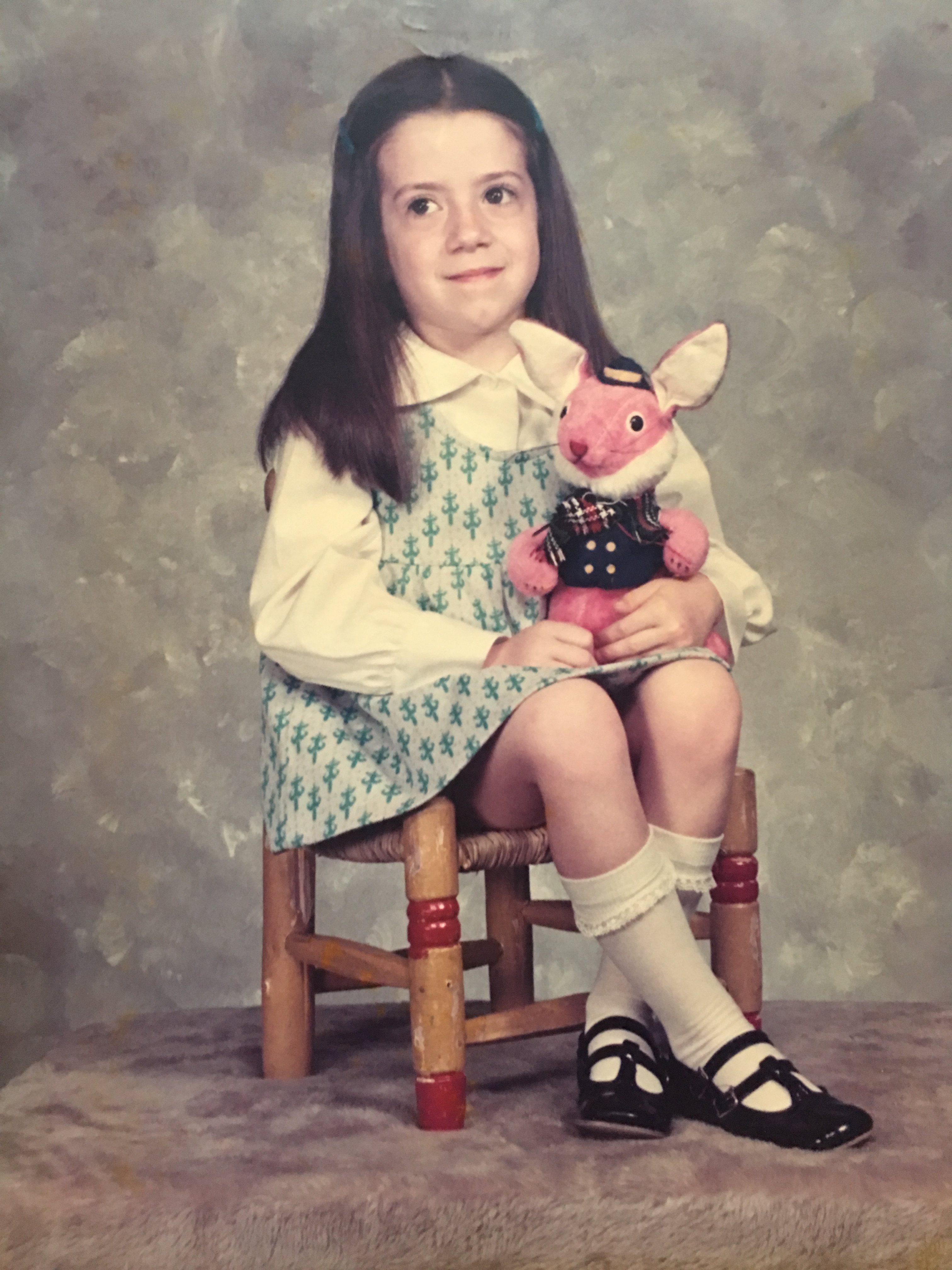
I mean, c’mon. Who DOES this to a kid?

And, yes, that’s me.

That’s me holding a hot pink sailor bunny with a chin curtain and a tartan scarf tied around its neck. And you wonder why my lips are pursed.

And, before we move on, can I just say that black patent shoes are all that is wrong with humanity?

Hate.

Like, I feel an actual, physical loathing for them.

I have some big feelings about black patent shoes.

Also, white, fold-over knee socks.

Again, why do we do these things to our children?

But lest you think I’m any better than the rest…

I give you this.

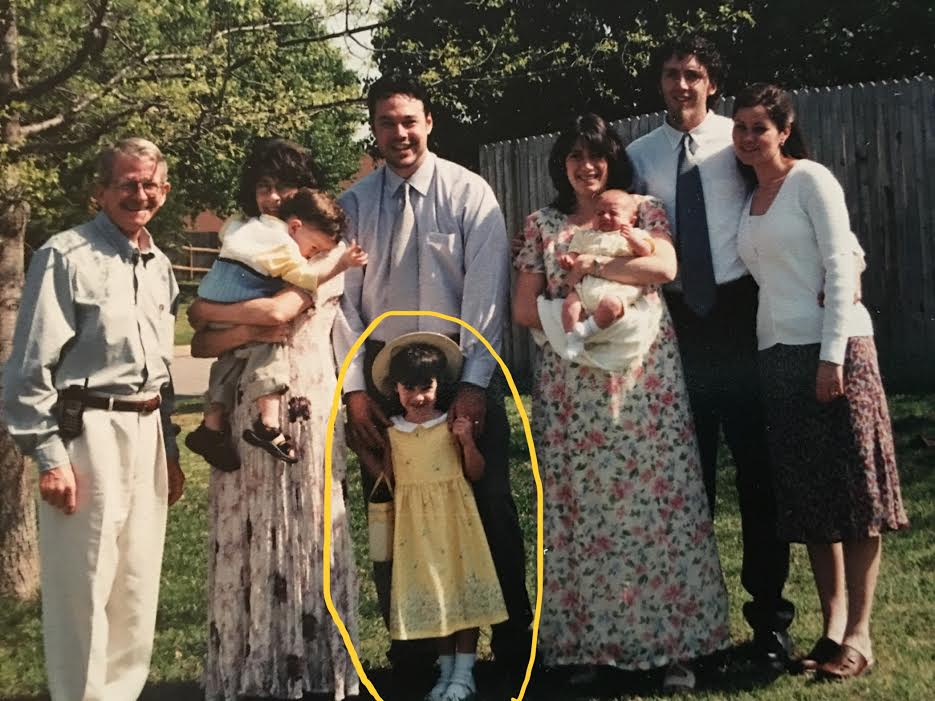
Easter, 2001

Yes, that’s my precious daughter in fold-over white socks.

Thank GOD, I was able to hold the line on the black patent shoes, though. Whew.

And then there’s this.

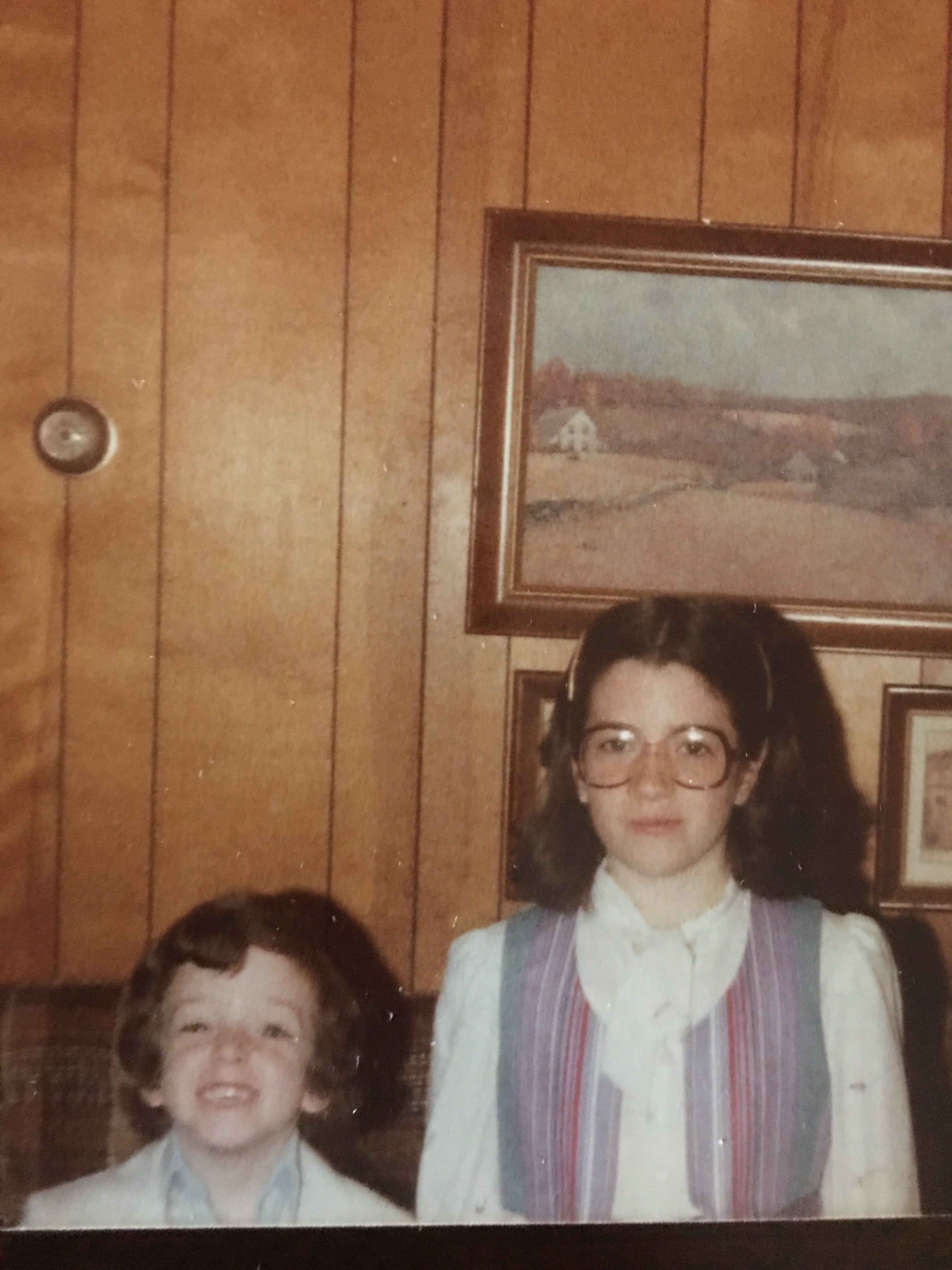
There’s those pursed lips again. It’s a thing. And God bless my mom, she never could frame a picture.

I was about ten this particular Easter, I think.

Full-on awkward. And feeling every bit of it.

What I really remember about this Easter, though, is that dress. That dress left an impression in my memory because it was purchased for me as an act of kindness by a woman in our church. She picked me up and took me shopping for it and everything. It was so very kind (and kind of awkward, if I’m being honest… I mean, I was TEN). I remember actually liking the dress pretty well, which is saying something considering I was a regular Scout Finch who considered (ahem, consiDERS) the required wearing of dresses punishment akin to a beating.

But I also remember a deep sense of embarrassment the entire day.

And again on that Easter Sunday when I had to wear it to church.

Instead of gratitude for this gift I had been given, all I could feel was shame because I felt I was wearing something I hadn’t earned. That my family hadn’t earned.

Because I didn’t earn it. My family didn’t earn it.

My father didn’t earn it.

And, you see, that was the problem. In my mind, if I didn’t earn it, if HE didn’t earn it…I didn’t deserve it. Also, I knew for certain that gifts came with strings attached, and those strings were never attached to the kind person who gave the gift, but to my alcoholic father who felt the shame just as strongly as I did. He just couldn’t tolerate it nearly as well as I could.

And this is the problem with Easter.

Easter is all about the ultimate gift with no strings attached.

Much like that Easter Sunday when I was 10, I often feel as if I’m walking around wearing, in the form of salvation, a gift I haven’t earned, one I don’t deserve, or at the very least, one that comes with strings attached.

Deep down, I know the truth. Of course I do. I read about the truth, I talk about the truth, I write about the truth. It’s kind of embarrassing, really. I intentionally speak the truth over my children because I desperately want them to walk in truth, but I struggle to embrace the truth for myself.

I guess that’s not so off the beaten path, actually. In fact, my therapist likes to tell me this on a regular basis. There’s a lot of us out there in the same boat.

I’m kind of starting to believe her.

Especially now that Brené Brown has a Netflix special where she basically says the same thing.

Shame is a powerful thing. Once it attaches itself to you, it’s quite something to detach it. It’s some nasty, sticky stuff, with the ability to slime its way into the innermost crevices within you, making freedom from it feel like an impossibility.

During the Easter season, shame speaks louder to me than usual and says things that are super fun (not) to hear about my worth (lack of) as a child of God.

It’s a problem.

I’m working on it. The more work I do, the greater the battle I see I have ahead of me.

Trauma is a beast.

Recognizing the origin of the problem is though, I think, more than half the battle, so I’m grateful to be able to say that I’m more than halfway there now that I’m more than halfway through my lifetime.

I’m also really, really grateful that hot pink bunnies with chin curtains and tartan scarves are a thing of the past.

And guess what?

So are dresses if I want them to be.

Memory Punch

I’ve always found it interesting to listen to my friends talk about their childhood memories because many of them have so many memories connected to people and places. I’ve often felt like the odd one out when we sit together and share our pasts because I can’t recall things like the names of my kindergarten and first grade teachers or the names of any of my friends before the age of seven, the names of any of the friends I had my junior or senior year of high school outside of that one girl in my youth group and the youth group leaders my senior year.

Yeah, that makes me feel weird.

But I do remember the day in second grade when I was in maybe my second or third week of Brownies and learned what poison ivy looked like and what it would do to me if I was to come in contact with it.

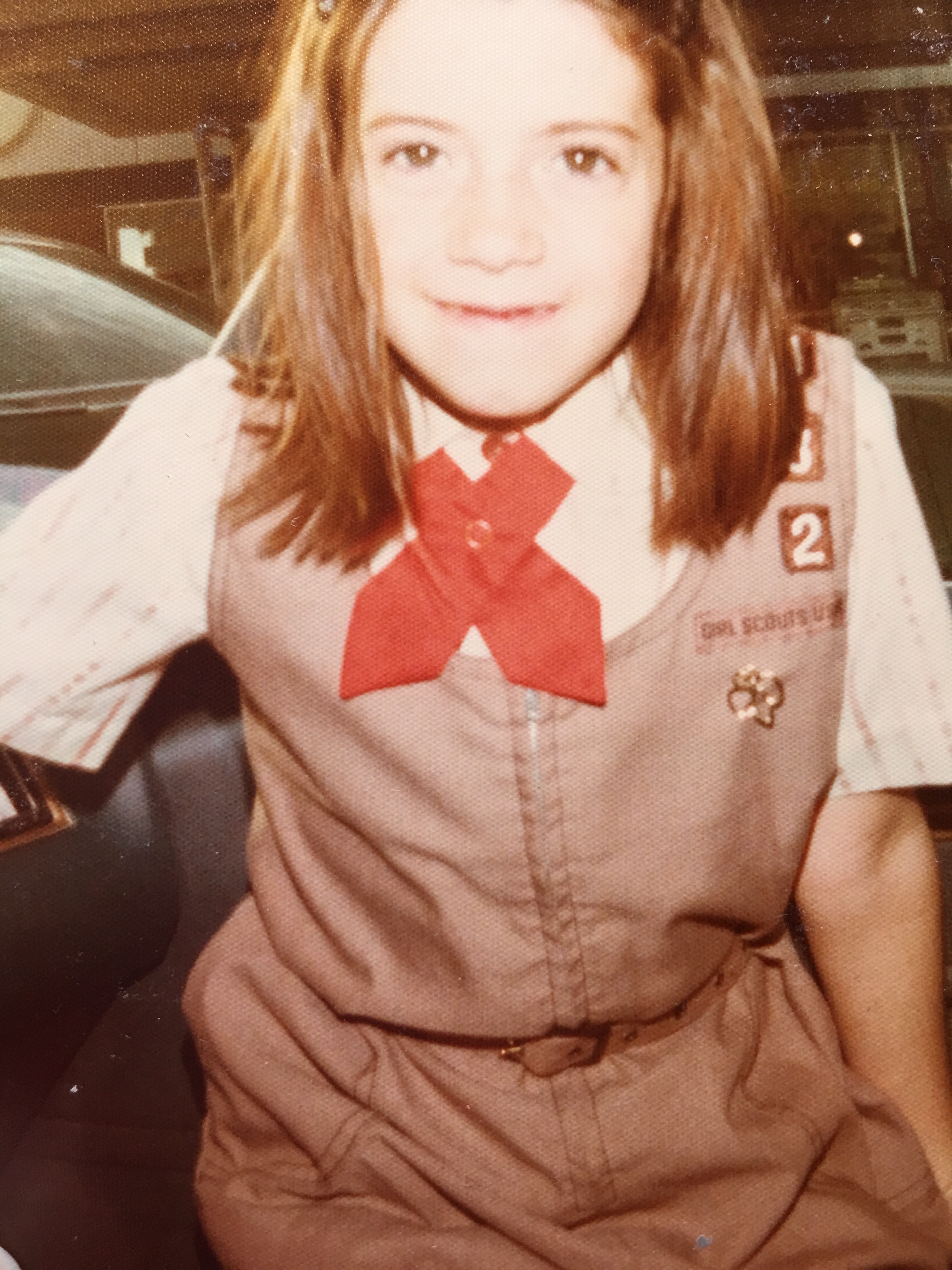
Me as a Brownie. My days in this uniform were numbered as you will see.

I remember that day because I thought those grownups were idiots.

How in the world could a plant do that?

I was sure it couldn’t. So I rallied together a few fellow rebels at the park on the day we were supposed to walk around and just “spy” this so-called malevolent vine and then draw a picture of it in our nature journal (ridiculous assignment, by the way), and instead convinced my compatriots to join me in an act of boldness that would surely prove the adults were feeding us a load of crap.

And rub that so-called poison…

ALL. OVER. OUR. BODIES.

We sure did.

Stupid grownups don’t have a clue.

Of course within a few hours I began to itch. A short time after, a rash began to appear. My left arm and my right leg were particularly bad, for some reason.

The next day, little blisters began to rise up, but what was particularly alarming was the swelling that began in both of those areas. It got so bad that I couldn’t bend my arm or my leg.

My mom flipped out, so upset that the Brownie leaders had us actually LOOKING for poison ivy.

“Why in the world would they have SEVEN YEAR OLDS searching for that stuff?!!”

I’m no fool.

In fact, I continued to be no fool until I was a grown up woman and even then made sure Mom was in a great mood before I told her the truth about that fateful day.

You guys, I ended up getting two rounds of steroid shots and missing two weeks of school over that little stunt.

But I definitely remember it.

And I’ve discovered that if a moment in my childhood and adolescence didn’t come with that kind of a punch, it just didn’t stick.

I guess when you’re busy trying to take care of the needs caused by your alcoholic father, you kind of don’t have a lot of room in your mind for remembering less important things like the name of your kindergarten teacher.

I do remember the name of my second grade teacher, though.

Mrs. Fesmire.

She actually wasn’t my FIRST second grade teacher.

She was my SECOND second grade teacher.

That was fun to say.

We moved back to my hometown of Jackson, Tennessee in October of my second grade year after living in Nashville for two years while my father tried his hand at store manager for JC Penney and then decided he wasn’t well-suited for the job, and somehow thought a traveling salesman was more his style.

I think what was actually more his style was a per diem, total anonymity on the road, and the freedom to sit and drink at any bar he wanted in each town he landed each night.

Anyhoo, back to second grade… moving back to Jackson was a good thing for us. Somehow we were able to buy a little house in a neighborhood with loads of kids, and we were back in town with family.

I started my new school with great anticipation.

But things got off to a rocky start.

Apparently, Mrs. Fesmire had a particular handwriting style she expected all of her students to have mastered by the time they came to her classroom (as second graders, mind you), and I did not have this style mastered. In fact, I didn’t know anything about this style because in Nashville, I learned a completely different handwriting style.

After a few days of instruction (you know, because most seven year olds have amazing dexterity and are able to pick up new handwriting techniques lightning fast), I had yet to reach her level of expectation and so she began to lose patience with me.

One day she began to stand at my side while I practiced, and when I made a mistake she slapped the back of my shoulder.

Hard.

That was a surprise.

That went on for a few days, then she began to keep me in from recess and make me write sentences. And to add insult to injury, she stood over me slapping my arm or shoulder when I made mistakes.

Dolores Umbridge, anyone?

I’m not even kidding.

So this went on for a few weeks. I think I tolerated it for so long only because the kids in the class really rallied around me. I was the new kid, so it felt really good when they became so fiercely loyal and began to try to scheme with me ways I could get eventually get revenge.

I mean, really, those kinds of moments are some of my favorite childhood memories. How weird is that?

Not the teacher-slapping-me moments, to be clear. The kids-rallying-around-me-BECAUSE- the-teacher-was-slapping-me moments.

Important distinction to my neuroses.

But the day finally came when I’d had enough.

Fesmire had had enough, too, I guess, because that day, when I made my usual handwriting mistake, instead of slapping my arm or shoulder, she hit me on the back of the head.

Nope.

Done.

I’m out of here.

The next day I decided I was sick.

And the next day.

And the next.

And my beautiful, savvier-than-she-let-on mother deduced that something was up.

We had a little chat. And the thing was, I trusted my mother. I knew she loved me desperately and wanted to take care of me, but I also had a pretty clear sense that my father sometimes stood in the way. And I also sensed that often she was drained of all that she had because he took it all from her, so she did her best, but her best didn’t always mean that I got what I needed.

But that day she stood up for me.

And I know this because I never remember another problem with Mrs. Fesmire.

We never talked about it. It’s just that I was never hit again.

It always kind of nagged at me that we never talked about it, though. I mean, granted, we had much bigger fish to fry. Still, it was a pretty big fish in my Fry Daddy. But I tucked it down deep with all the things as was my go-to coping style and occasionally told the story as an anecdote at a party that usually made people chuckle uncomfortably while I guffawed, not understanding what the discomfort was about.

Then, a few weeks ago, my brother and I set aside a day while he was visiting with the intention of finally going through boxes of Mom’s things that remained to be sorted since her funeral over a year ago. This was a daunting task, not because of the amount to go through (she had pared down her material things to a very few), but because we knew these particular boxes contained all the memorabilia that she had considered most important from her life – from our lives.

There are many posts to be written about what we found in those boxes, but what is pertinent to this post is this: My mom kept many of the things my brother made or wrote during his elementary school years. Meaningful things, to be sure, but many things. But she only kept one thing from mine.

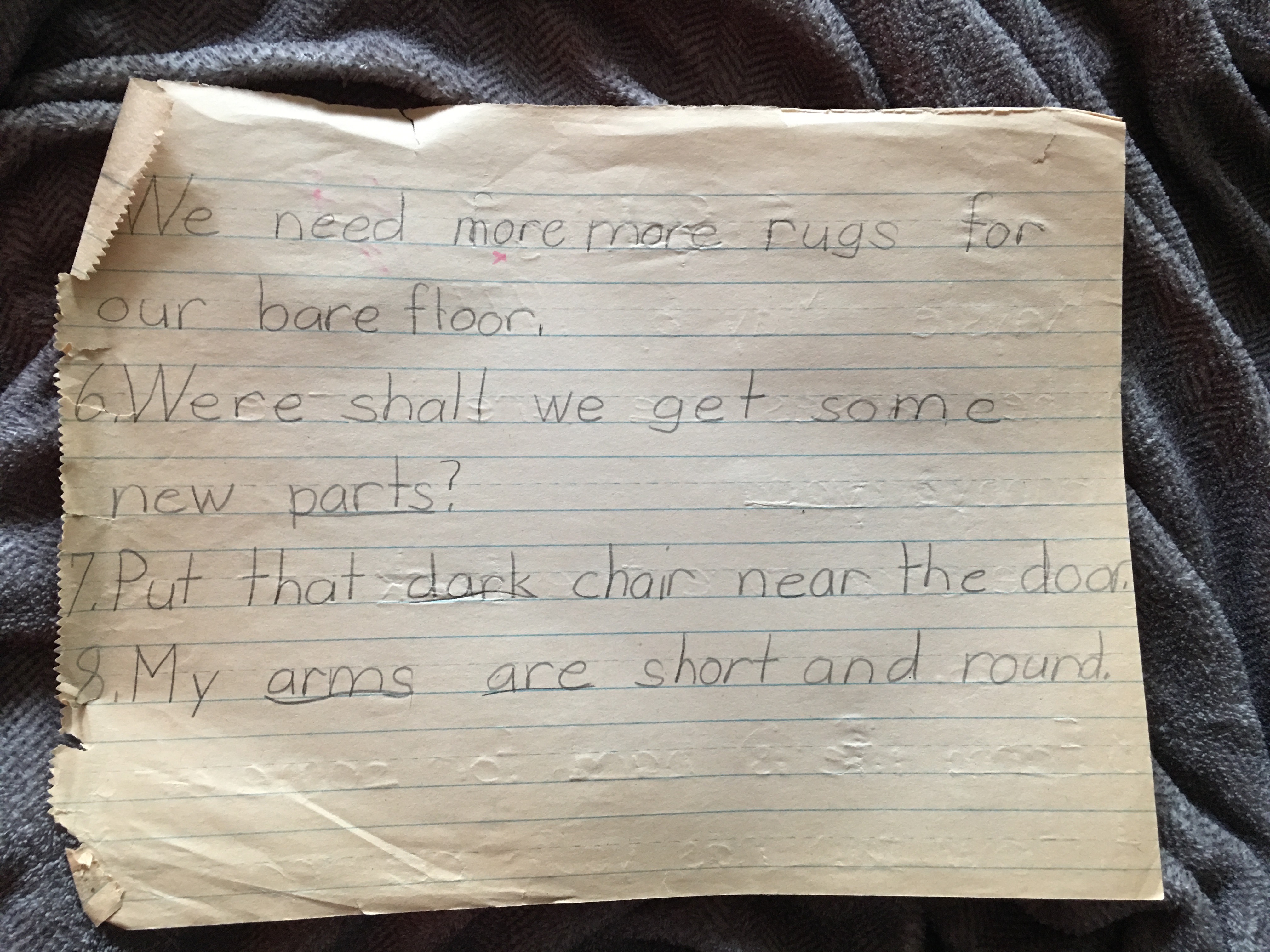
She kept about a dozen samples of my second grade handwriting.

My 9 year old son, Davy, says this is great handwriting, by the way. I have to agree. What was wrong with that woman? Sheesh.

When I pulled those samples out of the box, my heart started beating fast, and I felt a rush of emotion that I feel washing over me even now as I write this.

She was 27-years old when she went to bat for me that day. A 27-year old young woman drowning awash as she faced life as a mother with two young children with little to no support from a deceiving, foolish, negligent husband (and this is being generous).

And what I thought was to her just something she “took care of” on the list of all the things that had to be taken care of that day was actually just as monumentally meaningful as it was to me.

It carried that all important punch… for both of us.

And it feels really good to know that now.

Context is Everything

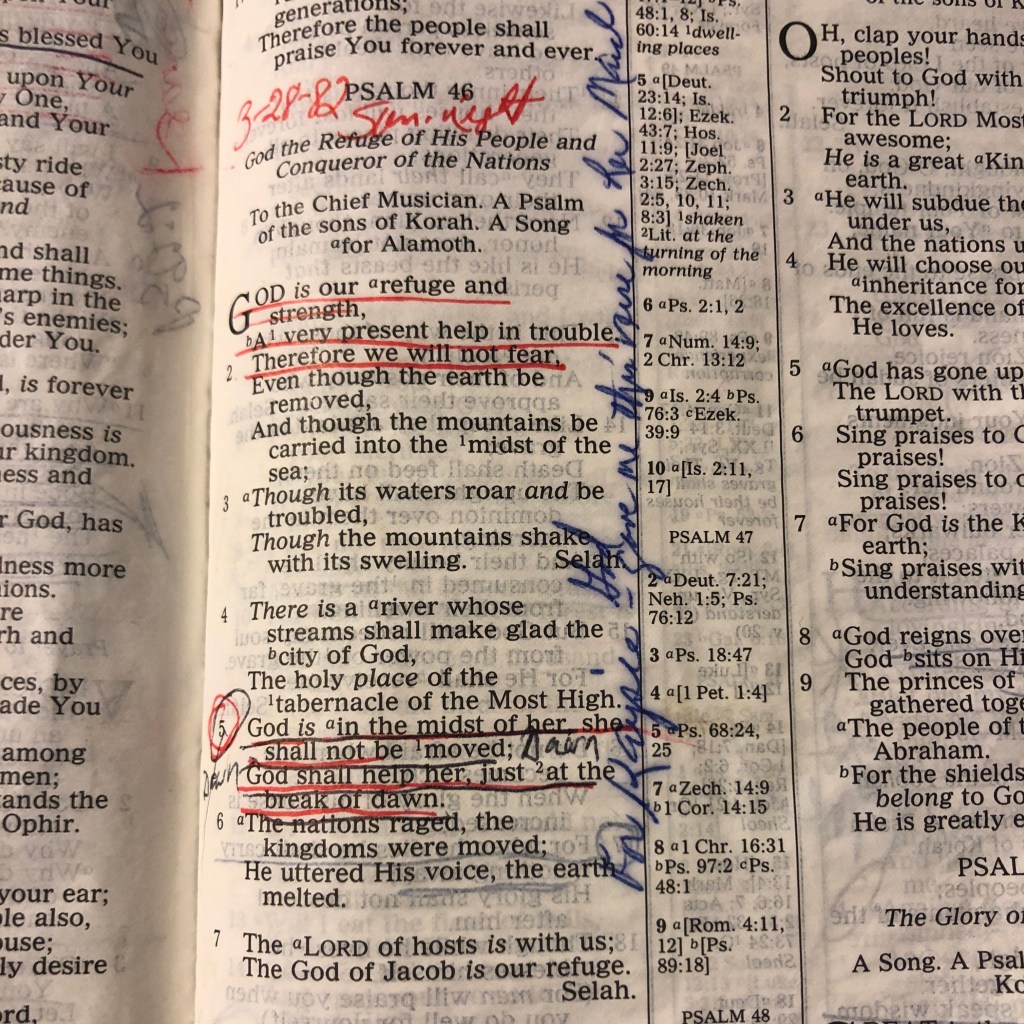
My Mom had Psalm 46:5 marked in her Bible with “For Kaysie” written next to it for as long as I could remember.

God is within her, she will not fall; God will help her at break of day.

It comforted me knowing she was believing this for me and praying this for me even though, to be honest, my own faith for believing this as truth was shaky.

I figured, though, that I could afford to be a little shaky with my mom standing in my stead.

Her faith was solid. I took full advantage of the “by proxy” role she was more than happy to play and let her faith it up for me. I did this despite all evidence to the contrary that there was any real truth to her stance, because, God bless her, even though she was a fiery little woman with a big heart and even bigger dreams – especially for her now fully grown children – her life had mostly been one hard knock after another. And, truthfully, my brother and I had often suffered right along with her.

So, as you can imagine, it was hard for me to align myself with her belief system even though, hypocritically, I really did rely on it kind of as an insurance plan.

You know – if my way of thinking about God and reality and things didn’t work out then I would have mom’s to lean into.

And then she died.

And the loss of her – a loss like none other I’ve known – also meant the loss of my proxy.

And suddenly, Psalm 46:5 – yes, the tagline at the top of my shiny new blog – became really problematic for me.

The amount of time I have spent stewing over this verse in the last year is embarrassing. Sometimes I read it and let it wash over me and soothe my grief. Sometimes I read it and fume because very little in my life (or in most lives, for that matter) lines up with what’s being stated here. Oh, the contradiction!

Yes, I can be dramatic. Whatever.

And then, not long ago when we passed the one year mark of Mom’s death, I had a brilliant idea that I’m sure no other person in the history of the world has ever had before me.

I decided to read the verse in the context of the WHOLE PSALM.

Yes, sometimes I’m a really smart idiot.

Whatever.

So I did. I read the whole Psalm.

And, oh my.

And, wait a second.

All of a sudden I realized that verse 5 is not talking about a person . It’s not really referring to me at all.

GASP.

IT’S NOT ABOUT ME?

Actually, silly girl, the Psalmist is referring to the city of God.

He is within HER (the city of God). SHE (the city of God) will not fall. God will help HER (the city of God) at the break of day.

Now, that’s not to say that God isn’t with me and helping me.

I believe He is.

But what I love about this verse of Scripture is that it’s actually sandwiched in between these descriptions of great devastation happening all around the city of God. The earth is giving way, the mountains are falling into the heart of the sea and quaking, nations are in uproar, kingdoms are falling, and so on and so forth.

I mean, we’re talking apocalyptic-type stuff here.

Not to be too dramatic, but sometimes I can relate.

And I’ve decided that this Psalmist is a bit of a crazy psalmist (and kind of reminds me of my therapist – who I adore, by the way) because then at the end of this song about the coming devastation of the world, when all of us are trembling with anxiety and fear and overwhelmed with big feelings about what we cannot control, all of a sudden he brings everything down to almost a whisper that says “Be still, and know that I am God. “

For the love, man.

Does he have any idea how hard that is?

Yeah, he probably does.

Sigh.

I know I should give the guy some credit for starting the whole Psalm off by reminding us that God is our refuge and strength, but the truth is, sometimes, when the world is falling apart around you, it’s really hard to remember this.

And even if you remember He’s got a safe place for you to run to when you’re tired, scared, hurting, overwhelmed and your world is literally melting underneath you, you may have forgotten practically how to get there. Or how to practice being there.

Because it’s very hard to “be still” when the mountains are falling into the heart of sea and the waters roar and foam.

But, in the end, despite all of my wrestling and challenging and foundation-shaking questioning, I think I’ve come to a pretty solid conclusion…I don’t believe that God keeps us from falling or even very often saves us at the break of day, but I DO BELIEVE that He offers us a safe place in Him (the city of God) that WILL NOT FALL where we can go to find help at the break of day…and peace and comfort and rest in the midst of whatever devastation we are facing.

So I feel like Mom was on to something when she wrote “For Kaysie” beside that verse.

I’m owning my tagline.

P. S. As part of my journey in learning to dwell in the “city of God” as my world is crumbling around me (or is noisy, or I’m in physical pain, or just tired, or anxious, etc.), I’ve begun to practice this simple prayer of being from Fr. Richard Rohr that is beautifully described here: https://gravitycenter.com/practice/be-still/